If you’ve ever stopped to admire a clear acrylic box holding a delicate watch, a batch of perfectly preserved vintage postcards, or even a set of custom-made artisanal candles, you might have glanced through the sides and thought: why does this plastic feel so much clearer than the cheap plastic containers I use for leftovers? As an acrylic box supplier, I get this question all the time—not just from curious hobbyists picking up their first display case, but from small business owners curating product showcases, or even engineers testing light transmission for retail setups. Today, I want to break down the specific refractive index of acrylic in our boxes, why it matters beyond just textbook definitions, and how that tiny number makes our display boxes worth the investment, no matter what you’re storing inside. Acrylic Box

First, let’s start with the basics, because I don’t want this to turn into a stuffy science lecture. Refractive index (usually written as “n”) is a simple measurement: it tells you how much light slows down when it passes through a material, compared to how fast it travels through a vacuum (which we say has an n of exactly 1.0). When light moves from one material to another—say, air, which has an n of roughly 1.0003, to a piece of acrylic—it bends, or refracts, at a specific angle based on that n value. That’s why straws look broken when you stick them in water, too: water has an n of about 1.33, so light bends when it moves from air to water, creating that illusion.
Now, not all acrylic is created equal, and that’s a key point most cheap box makers don’t tell you. The acrylic we use for our display cases is standard optical-grade polymethyl methacrylate (PMMA) — the same stuff used in eyeglass lenses, car windshields, and museum display cases that need ultra-clear, distortion-free views. For this grade of acrylic, the refractive index ranges from 1.490 to 1.492 when measured at the common visible light wavelength of 589 nanometers (that’s the yellow light emitted by sodium lamps, a standard baseline for optics). That number might seem small, but its real impact comes when you compare it to other common materials. Glass, for example, has a refractive index of roughly 1.52 for soda-lime glass (the kind used in most windows and drinking glasses), which is higher than our acrylic’s. That difference in n might sound trivial, but it creates a huge visual effect.
Let me explain that. When light hits the surface of a material, some of it reflects back instead of passing through. The higher the refractive index, the more light reflects. So glass, with an n of 1.52, has about 4% of light reflecting off each surface. Our acrylic, with an n of 1.49, only reflects about 3.7% of light per surface. That might not sound like a big difference until you see two identical objects displayed side by side: one in a glass box, one in an acrylic box. The glass box has those subtle, bright reflections that can wash out the item inside, especially in bright store lighting or direct sunlight. The acrylic box has almost no glare, so the focus stays on your product—not on the box itself. For jewelers displaying engagement rings, for example, that tiny reduction in reflection can make the sparkle of a diamond pop in a way glass can’t match, because the diamond’s own light refraction isn’t being blocked or distorted by box reflections.
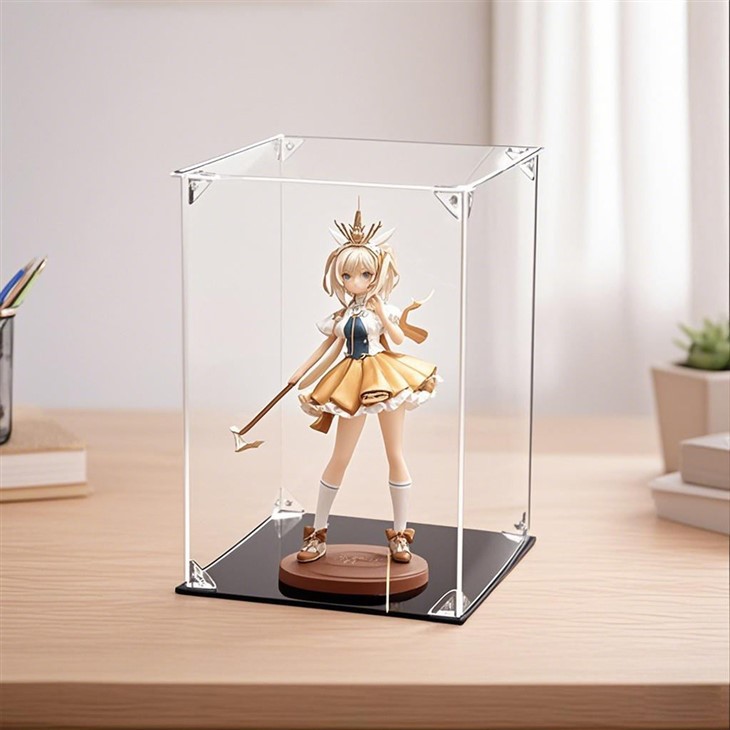
Wait, you might be wondering: why does the refractive index of acrylic matter inside the box, not just through the walls? Let’s say you’re displaying a small figurine inside an acrylic box. When light passes from the air inside the box (n=1.0003) through the front acrylic wall (n=1.49), it bends, then bends again when it exits the back wall of the box to reach your eye. That double refraction—called specular transmission—will distort the view if the acrylic has inconsistent refractive index values. That’s another reason we only use optical-grade acrylic for our boxes, not the cheaper, industrial-grade acrylic used for things like drain pipes. Industrial acrylic often has slight variations in its molecular structure, which means the refractive index changes by small amounts across a single sheet. That can create wavy, distorted views of whatever’s inside the box, or even make text look blurry when you look through the side at a printed item. Optical-grade acrylic is manufactured under controlled conditions, so its n is consistent within a 0.001 range across the entire sheet. For our boxes, that means no wavy lines, no distorted edges—just a crisp, clear view of your product, no matter which angle you look from.
I’ve seen this difference firsthand, because I’ve worked with hundreds of clients testing different box materials. A few years back, a local craft brewer came to me because they were selling their bottles in glass display boxes at farmers’ markets, but customers kept saying the labels looked “fuzzy” and hard to read from a few feet away. They tried switching to acrylic boxes from a big-box retail supplier first—you know, the ones that sell cheap, thin acrylic boxes for next to nothing. Those had a distorted view, because their acrylic had inconsistent refractive index, and the boxes were made from thin, low-quality sheets that flexed slightly in the sun, making the refraction even worse. When they switched to our optical-grade acrylic boxes, they noticed an immediate difference: the labels were sharp, no glare, and customers commented that the beer bottles looked cleaner and more professional. They ended up ordering 500 boxes for their seasonal line, and now they’re a repeat client every year.
Another common question I get: does temperature or lighting affect acrylic’s refractive index? The short answer is yes, but it’s negligible for the types of environments our boxes are used in. The refractive index of acrylic drops slightly as temperature increases, because higher temperatures make the material’s molecules spread out, so light travels a tiny bit faster. For example, if our acrylic box is sitting in 100°F storefront sunlight (a common scenario in the summer), its refractive index drops from 1.491 to about 1.489. That’s a change of 0.002, which means the reflection per surface goes from 3.7% to 3.6%, a difference so small most people can’t notice it. It also doesn’t change based on the color of the acrylic, by the way. We offer clear, frosted, tinted, and colored acrylic boxes for clients who want a more branded or private display—all of those have the same core refractive index for the clear acrylic portion; the colored tint is just a dye added to the acrylic during manufacturing, which doesn’t alter the molecular structure enough to change n.
Let’s also address a myth some people believe: that acrylic’s lower refractive index makes it “less clear” than glass. That’s not true at all. The perception of clarity depends on more than just refractive index. Glass, for example, has a higher refractive index, but it’s also heavier, more prone to scratching, and more likely to crack if it’s dropped. Acrylic, on the other hand, is 17 times more impact-resistant than glass, so our boxes hold up better for long-term displays, trade show booths, or storage of fragile items. The lower refractive index actually helps with clarity by reducing glare, as I mentioned earlier. If you’ve ever held a pair of acrylic reading glasses, you’ll notice they have almost no glare compared to glass lenses, even though their refractive index is lower—and that’s exactly the same effect as our acrylic boxes.
Now, I know this might sound like I’m just talking about science, but as an acrylic box supplier, this refractive index is a big part of what makes our boxes a reliable choice for businesses and hobbyists alike. When you choose a box for your prized possessions or your products, you’re not just choosing a container—you’re choosing a material that will showcase what matters most, without distracting from it. The refractive index might be a tiny number in a textbook, but it translates to a huge difference in how your items look to customers, friends, or potential buyers.
I’ve spent years refining how we source and use acrylic for our boxes, because I’ve seen firsthand what happens when you cut corners on material quality. A client once told me they switched to a cheaper acrylic box because it was half the price of ours, only to have it crack after two weeks of displaying a heavy ceramic mug collection on a shelf. Another client ordered a set of boxes for their pottery shop, and the cheap acrylic’s inconsistent refractive index made their hand-thrown mugs look lopsided when viewed from the side—something they didn’t notice until a customer pointed it out, costing them a sale. That’s why we prioritize optical-grade acrylic, consistent refractive index, and precise manufacturing for every box we make.
If you’re in the market for an acrylic box—whether it’s for product displays, personal storage, art showcases, or trade show booths—don’t just focus on price. Ask about the type of acrylic used, the refractive index consistency, and the manufacturing standards. Those small details make all the difference in how your items are presented, and how long your box will last.
I’m here to help you find the right acrylic box for your specific needs, whether you’re a small business owner testing a new product line, a collector preserving vintage memorabilia, or an event planner needing display cases for a pop-up show. If you have questions about refractive index, material specs, or custom sizing, feel free to reach out to discuss your requirements and get a quote tailored to you.
Pokemon Acrylic Case References
- Cowie, J. M. G., & Arrangement, V. (2008). Polymers: Chemistry and Physics of Modern Materials (3rd ed.). CRC Press.
- Serway, R. A., & Jewett, J. W. (2018). Physics for Scientists and Engineers (9th ed.). Cengage Learning.
- “Optical Acrylic (PMMA) Properties.” Evonik Industries AG, 2022.
Wenzhou Daoqin Crafts Co., Ltd.
With abundant experience, we are one of the most professional acrylic box manufacturers and suppliers in China. Please rest assured to wholesale bulk customized acrylic box from our factory. If you have any enquiry about quotation and free sample, please feel free to email us.
Address: Room 401, Building 5, Wanyang Innovation City, No. 9 Yangyu Road, Binhai New Area, Pingyang County, Wenzhou City, Zhejiang Province, China
E-mail: wzdaoqin@163.com
WebSite: https://www.wzacrylic.com/
