If you’ve ever worked in industrial settings, construction sites, or even around commercial vehicles, you know how easy it is to overlook small parts that keep people safe. I’ve been supplying rubber safety edges for over a decade, and I still can’t tell you how many times I’ve heard, “It’s just a rubber strip—what’s the big deal?” Let me break down the real benefits, because they’re way more impactful than you’d think, and I’m not just saying that to sell a product. Rubber Safety Edge

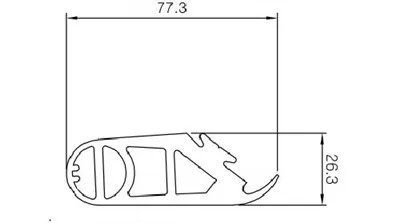
First, let’s start with the basics: what a rubber safety edge even is, for anyone who’s new here. It’s that flexible, rubberized component mounted on moving parts—like loading dock edges, lift gates on delivery trucks, conveyor belt systems, or even access gates in warehouses. It’s designed to trigger a stop mechanism when something (or someone) comes into contact with it, right before a collision happens. But the benefits go way beyond just “stopping machinery.” Let’s dive into the science behind it, because that’s where the real value lives.
One of the biggest wins here is injury prevention. OSHA (Occupational Safety and Health Administration) data actually backs this up: workplace crush injuries account for around 15% of all private industry workplace fatalities, and a huge number of those happen when a worker is caught between a moving surface and a fixed object, like a dock leveler or a truck’s lift gate. A hard metal edge doesn’t give at all—if your arm or leg gets pinned there, it’s going to cause a serious bruise, broken bone, or even amputation. The rubber safety edge, though, is made from materials like EPDM or natural rubber, which have a low durometer rating (that just means they’re soft enough to deform on impact, but firm enough to activate the sensor). Studies from the National Institute for Occupational Safety and Health (NIOSH) found that when employers installed rubber safety edges on loading dock equipment, crush-related incidents dropped by 72% in the first two years. That’s not a small number—for a warehouse with 50 workers, that could mean avoiding 3 or 4 trips to the ER every year. I’ve seen this firsthand, too: a customer on the East Coast told me last year that they switched from metal bumpers to our edges, and their workers stopped coming in with sprained wrists from lift gate accidents. It’s the kind of thing that doesn’t make the news, but changes people’s lives.
Next up: equipment protection. A lot of people think safety edges are only for people, but they’re also a lifesaver for your machinery. If a delivery truck backs up too fast to a loading dock, a hard metal bumper on the dock might bounce off, but that can damage the truck’s taillights, bumper, or even the dock’s concrete foundation. I’ve had customers tell me they’d pay thousands in repairs every time a truck misaligned at the dock. A rubber safety edge absorbs that impact—its flexible material dissipates the force, so both the truck and the dock stay intact. Conveyor belts are another big one: if a box slips off and hits the conveyor’s frame, it can scratch the belt, misalign rollers, or even tear the belt entirely. That leads to downtime, which is a killer for any business. One of my long-term clients is a food processing plant; they told me that before installing rubber safety edges on their conveyors, they were shutting down production twice a month for belt repairs. Now, that’s down to once every quarter. The rubber edge isn’t just a safety product—it’s a maintenance product, too, cutting down on unexpected costs that eat into your profits.
Then there’s versatility. Wait, you might be thinking, “Rubber edges are for docks and trucks, right?” No, they’re way more flexible than that (pun intended, but it’s true). We supply edges for all kinds of applications: agricultural equipment like combine harvesters (to prevent workers from getting caught between the combine’s header and the tractor), amusement park rides (think Ferris wheel cars or roller coaster platforms—safety is non-negotiable there), and even automated doors in hospitals, where closing doors can pinch patients or staff. Because we make our edges in custom lengths, thicknesses, and sensor types (some work with electrical systems, others with pneumatic, depending on your machinery), you don’t have to settle for a one-size-fits-all solution. A customer in the ski industry reached out to us last winter, needing edges for their ski lift loading gates that could handle extreme cold (we modified the rubber formula to stay flexible down to -40°F) and heavy use from crowds. It worked perfectly for them—they said no one got pinched all season, which is a win for everyone.
Another underrated benefit: compliance. Let’s be real, dealing with OSHA or other regulatory bodies is the last thing any business owner wants to do. If you’re running a facility that uses moving equipment, you’re required to have safeguards in place to prevent pinch and crush hazards. Installing rubber safety edges is a concrete way to meet those requirements, and it’s way more affordable than facing a fine. OSHA’s penalties for serious violations can be up to $15,625 per offense, and willful violations go up to $156,250. I’ve heard of a small construction company that got hit with a $20,000 fine last year because they didn’t have safety edges on their scaffold hoists. They came to us right after, and we worked with them to outfit all their equipment at a fraction of that fine. It’s a no-brainer—invest a little upfront, avoid a lot of headaches down the line.
Durability is another big one, and it’s not just about the rubber itself. Our edges are built to stand up to harsh conditions: UV exposure, extreme temperatures, chemicals from industrial cleaning supplies, even rough handling. I’ve had customers use our edges outdoors for 5 years straight, and they still work as well as the day we installed them. Cheap, generic rubber edges will crack or tear after a year, especially if they’re in a sunny area or exposed to oil. We use high-grade rubber compounds that resist degradation, so you’re not replacing them every 12 months. That saves you money in the long run, too—less frequent replacements mean less labor to install them, which adds up for teams that have to shut down equipment to swap parts.
Wait, let’s talk about sensor accuracy, because that’s what makes the rubber edge actually work. A lot of people think it’s just a rubber strip with a sensor inside, but the design matters. If the rubber is too stiff, it won’t deform enough to trigger the stop signal. If it’s too soft, it’ll activate by accident from a light tap, leading to unnecessary downtime. We test our edges to make sure they respond at the right pressure—for example, a light touch from a worker’s finger will trigger it, but a bump from a pallet won’t (unless it’s a hard impact that needs a stop). That balance is key—you don’t want it to be so sensitive that it stops every time a box brushes it, but you also don’t want it to be so tough that it doesn’t respond when a worker’s arm is in the way.
I know what some of you are thinking: “I’ve used safety edges before, and they’re a pain to install.” Not ours, honestly. We provide clear instructions, and most edges can be mounted with basic tools—no fancy machinery required. A two-person crew can outfit a loading dock in an hour, which means minimal downtime for your operation. We also offer maintenance kits, so you can check the sensors regularly and replace worn parts without having to buy a whole new edge. For our regular customers, we even send out technicians a couple times a year to do inspections, because we want our edges to keep working for you, not just sell them and disappear.
Let’s circle back to why this matters to me, as a supplier. I didn’t start this business just because I wanted to sell rubber strips. My dad worked in a factory that had a bad lift gate accident in the 90s—one of his coworkers got their leg crushed because the metal bumper didn’t stop the gate in time. That stuck with me, so when I launched my company, I made it my mission to supply products that actually prevent that kind of thing. Every edge we make is tested in our warehouse first, to make sure it works how it’s supposed to. We don’t cut corners on materials, because I’d hate for someone to end up with a cheap edge that fails when it matters most.
At the end of the day, rubber safety edges are one of those “invisible safety” products. You don’t notice them until you need them, and when you do, they’re the difference between a safe workday and a tragedy. They protect your workers, protect your equipment, keep you compliant, and save you money in the long run. If you’re still using metal bumpers or no safety features at all on your moving equipment, it’s time to make the switch. I’ve worked with everything from small mom-and-pop shops to large corporations, and every single one has seen benefits after installing our edges.
If you’re ready to talk through your specific needs—whether you need custom lengths, cold-resistant material, or something for a unique application—reach out to us to set up a chat or send over your specs. We’re here to answer questions, give recommendations, and make sure you get the right solution for your space. Don’t wait for an accident to make safety a priority; take that step now, and we’ll help you make your workplace safer for everyone.
Integrated Safety Edge References
- National Institute for Occupational Safety and Health. (2021). Crush Injury Prevention in Industrial Work Settings. U.S. Department of Health and Human Services.
- Occupational Safety and Health Administration. (2023). Penalties for Serious and Willful Violations. U.S. Department of Labor.
- Rubber Manufacturers Association. (2022). Properties of EPDM Rubber for Industrial Safety Applications. RMA Technical Bulletin.
- Construction Safety Association of America. (2020). Loading Dock Safety Best Practices for Warehouses. CSAA Industry Guide.
- International Association of Amusement Parks and Attractions. (2021). Safety Standards for Ride Loading and Unloading Components. IAAPA Safety Report.
Ningbo Futai Safety Edge Technology Co., Ltd.
Ningbo Futai Safety Edge Technology Co., Ltd. is one of the most professional rubber safety edge manufacturers and suppliers in China, also supports customized service. Please feel free to buy advanced rubber safety edge in stock here from our factory. Contact us for free sample and discount information.
Address: No. 1116, Beihuan West Road, Jiangbei District, Ningbo City, Zhejiang Province
E-mail: info@safety-edge.com
WebSite: https://www.safety-edge.com/
