If you’re running a WPC (Wood-Plastic Composite) profile production line, few things derail your day faster than a machine defect that spits out uneven, faulty profiles instead of the smooth, consistent product your clients expect. As a WPC profile machine supplier who’s worked with production facilities across North America for the past seven years, I’ve seen every common defect—from surface blisters to wavy edges to inconsistent density—and the good news is most are fixable without a full machine overhaul. The key is knowing what causes each issue, how to diagnose it quickly, and how to adjust your line to get back to production fast. WPC Profile Machine

First, let’s ground this in what WPC profiles actually are: a blend of wood flour (usually 40–60% of the mix), thermoplastic (polyethylene, polypropylene, or PVC), and additives like coupling agents, stabilizers, and pigments. The profile machines extrude this heated, molten mix through a shaped die, then cool and calibrate it to lock in its shape. Defects almost always stem from one of three places: raw material inconsistencies, machine setup, or process parameters. Let’s break down the most common defects, how to spot them, and how to fix them step-by-step.
One of the most frustrating defects is surface blisters or bubbles on the profile. I’ve had a customer in Ohio shut down their line for eight hours last year because their new 150mm decking profiles were covered in dime-sized bubbles, and they were this close to losing a $200k order. When I walked through their line, the first thing I checked was the raw material mix—they’d accidentally ordered wood flour with too high a moisture content (over 2%, when the ideal is 0.2–1%). That extra moisture turns to steam when heated in the extruder, and since WPC’s wood particles trap gas better than pure plastic, that steam becomes bubbles. The fix here is simple, but easy to miss: test your wood flour moisture content regularly with a portable moisture meter (I recommend the Protimeter Mini for on-site checks, it’s small enough to keep in your toolbox) and store raw materials in climate-controlled bins, not open pallets in a warehouse. If blisters already exist, you can also check if your extruder’s vent port is clear—most single-screw extruders have a vent to release excess gas, and if that’s clogged with plastic residue, it won’t pull the steam out. A quick 15-minute clean of the vent with a brass brush will clear that, too.
Next, uneven density or inconsistent profile thickness. This shows up either as thin spots in the middle of the profile (common for window frames) or thicker edges on decking, and it’s almost always tied to die calibration. The die is the part of the machine that shapes the molten WPC into the final profile, and if the die’s lip screws (the small bolts that adjust the gap across the die) are misaligned, the material will flow faster in some areas than others. I saw this at a customer in Texas who was producing WPC railings and had 10% of their product rejected because the profile was too thin at the top edge. Their line tech had adjusted only the main die temperature and skipped checking the lip screws. To fix this, first run a 1-foot test extrudate when you’re changing profiles, then use a thickness gauge (a digital micrometer works for small profiles, a laser scanner for large decking) to measure across the entire width. Tighten or loosen the lip screws in small increments (1/8 of a turn at a time) until the thickness is consistent. Also, check the die temperature: if one section of the die is 10–15°F cooler than the others, the material will be stiffer and flow slower, leading to thick spots. Use a thermocouple to map die temperatures every shift, not just at startup—thermocouples can drift over time, especially if they’re exposed to molten plastic.
Another common defect is wavy or curved profiles after cooling. This is a big one for long profiles like decking or fence rails, because a 10-foot curved profile is impossible to sell as straight. The cause here is uneven cooling—if one side of the profile cools faster than the other, it shrinks more, pulling the profile into a curve. I had a customer in Florida deal with this last summer; their profile line’s cooling bath was too shallow, and the water level on the right side of the profile was 2 inches lower than the left, so that side cooled slower. The fix here is to make sure your cooling calibration system (the water tanks or vacuum cooling units) has even water distribution. Add baffles to the cooling tank if needed to prevent water from pooling, and check the cooling water temperature (it should be between 60–80°F, depending on the profile type) on both sides. You can also adjust the puller speed: if the profile is moving too fast through the cooling bath, the outer layer might cool before the inner core, leading to internal stress. Slow the puller speed by 5–10% for the first 5 feet after the die to let the core cool gradually.
Surface roughness or “orange peel” texture is another defect that turns off clients, especially for trim or window profiles that need a smooth finish. This usually comes from either low processing temperature or bad mixing of the raw materials. If the plastic isn’t fully melted, the WPC mix won’t flow smoothly through the die, leaving a rough surface. I once visited a line where the customer had set the extruder temperature 30°F lower than the recommended range to save energy, and their window profiles were so rough they couldn’t be painted. The fix here is to verify your extruder temperature zones: the feed zone (where raw materials enter) should be around 300–350°F, the transition zone (where plastic melts) 370–400°F, and the die zone 380–410°F for most polyethylene-based WPC. You also want to check your mixing screws: if the screw has worn flutes (the grooves that mix the material), it won’t blend the wood and plastic evenly, leading to rough spots. WPC screws wear faster than pure plastic screws because wood is abrasive, so plan to replace your screw every 2,000–3,000 production hours, and get a quality screw from a manufacturer that uses wear-resistant steel (like hardened 4140) to extend its life.
Now, let’s talk about process-specific defects: short shots or incomplete profiles. This happens when the extruder isn’t pushing enough material through the die, usually because of a clogged screen changer. The screen changer has filters that remove contaminants from the WPC mix, and over time, those filters get clogged with wood particles or plastic residue, reducing the flow rate. I’ve had customers forget to change their screens for 80 production hours, and their line would suddenly have half-finished profiles. The rule of thumb is to change screen changers every 20–30 production hours, or immediately if you notice a drop in extruder pressure (a pressure gauge on the extruder will alert you if pressure falls, which means flow is blocked). You can also use larger mesh screens (60–80 mesh) for coarser wood flour, and smaller mesh (100–120 mesh) for finer mixes, to balance contamination removal and flow.
Wait, I should also address a less obvious defect: color inconsistency. If your profile has streaks of different pigments, that’s usually from poor blending of raw materials before entering the extruder. Many small production lines just dump wood, plastic, and pigment into the hopper and call it a day, but manual blending leads to uneven color. The fix is simple: add a low-cost high-intensity mixer (I recommend the Henschel 10L mixer for small lines, which runs for a few thousand dollars) to blend the raw materials for 5–10 minutes before feeding them into the extruder. This ensures pigment is evenly distributed, and you’ll see color consistency across every profile. Also, make sure your pigment is compatible with your thermoplastic—some pigments don’t bond well with polypropylene, leading to streaks, so test a small batch of material before running a full order.
Now, what if you’ve tried all these fixes and the defect is still there? Sometimes it’s a worn machine part you didn’t notice. For example, the calibration plates (the metal parts that shape the profile right after it exits the die) can warp over time from high temperatures, leading to uneven pressure on the profile. A quick check: if you run a test extrudate and it’s straight for the first 2 feet then curves, that’s likely a warped calibration plate. You can either machine the plate flat or replace it—most calibration plates are affordable and easy to swap in 30 minutes. Another hidden issue is the haul-off puller’s grip: if the puller belts are worn or too loose, they’ll pull the profile unevenly, leading to waviness. Tighten the puller belts to the manufacturer’s specification (usually 50–70 psi tension) and replace them every 12 months if you’re running your line 24/7.
As a supplier, one thing I tell all my customers is that most defects are preventable with a regular maintenance schedule, not just emergency fixes. I’ve seen lines that run 24/7 for a year without a single breakdown because they do a 1-hour check at the start of every shift: test moisture content, check extruder pressure, map die temperatures, and inspect screen changers. The lines that skip maintenance end up with costly downtime and rejected product, which eats into profit way more than the small cost of regular checks.
If you’re dealing with a defect you can’t figure out, don’t hesitate to reach out. As a WPC profile machine supplier, I don’t just sell equipment—I provide ongoing support, from on-site troubleshooting to remote guidance via video call. I’ve fixed defects for customers in their lines in 30 minutes over a video call just by walking them through checking a clogged vent or misaligned lip screws, which saves them hours of downtime.
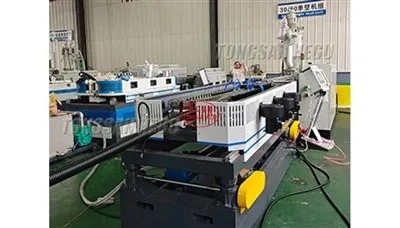
To wrap this up, fixing WPC profile machine defects doesn’t have to be complicated. It boils down to tracking raw material quality, maintaining your machine’s key parts, and adjusting process parameters carefully. Whether you’re dealing with bubbles, wavy profiles, or rough surfaces, the root cause is almost always one of the issues I’ve outlined here. If you’re ready to resolve recurring defects or upgrade your line to reduce downtime, don’t hesitate to connect for a conversation about your production needs.
WPC Door Machine References
- Klyosov, A. A. (2007). Wood-Plastic Composites. John Wiley & Sons.
- National Wood Flooring Association. (2019). WPC Profile Manufacturing Best Practices. NWFA Technical Bulletin.
- extrusion Online. (2021). Common Defects in WPC Extrusion and Mitigation Strategies. extrusion Media Group.
Qingdao Tongsanhegu Plastic Machinery Manufacturing Co., Ltd.
With abundant experience, we are one of the most reliable wpc profile machine manufacturers and suppliers in China. We warmly welcome you to buy durable wpc profile machine for sale here from our factory. Quality products and reasonable price are available.
Address: West of Xixinzhi Village, Sanlihe District Jiaozhou, Qingdao City, Shandong Province, China
E-mail: info@tongsanhegu.com
WebSite: https://www.tongsanhegumachine.com/
