If you’re a fleet manager, truck owner-operator, or someone who’s ever spent a weekend buffing 80,000 pounds of dust, road grime, and minor stone chips off a big rig, you know how brutal trucks are on exterior paint. For years, the go-to solution for passenger cars has been paint protection film (PPF), but the conversation around using the same PPF on commercial trucks has always felt a little murky. As the owner of a Flagship Clear PPF company—someone who’s spent the last seven years testing products, talking to fleet techs, and troubleshooting installation nightmares—I get asked this question at least once a week: Can Flagship Clear PPF be used on trucks? Flagship Clear PPF
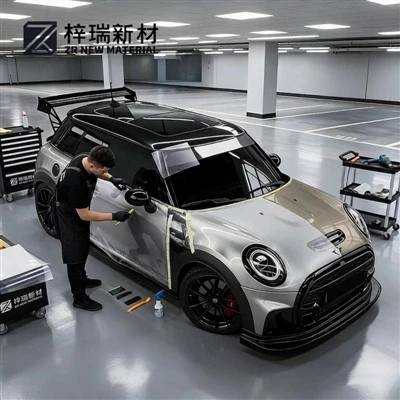
The short answer is yes, but it’s not a one-size-fits-all scenario. Let’s break this down like I do with my installation crew over morning coffee—no jargon, just the hard truths we’ve learned from covering everything from 18-wheelers hauling grain to delivery vans zipping around city streets.
First, I need to set the stage for why trucks are different from the sedans and SUVs most PPF brands are designed for. A passenger car sees maybe 50,000 miles a year, spends most of its time parked, and drives at consistent highway speeds. A long-haul truck? That’s 150,000+ miles a year, constant exposure to variable temperatures, and a daily parade of road debris—gravel from construction zones, kicked-up stones from other trucks, even salt in northern winters. Trucks also have way more surface area: a single 53-foot trailer has roughly 3,500 square feet of exterior, compared to a 1,800-square-foot passenger car. That means the PPF has to be durable enough to hold up to way more abuse, and the installation has to be precise enough to avoid peeling on edges that catch wind and road spray.
Back when I launched Flagship Clear PPF in 2016, we started with passenger car formulas because that’s what most of our initial customers were asking for. But within a year, a regional delivery company with 200 box trucks reached out saying their paint was chipping so badly from downtown pothole debris they were repainting every two months. That’s when we realized the standard PPF formulas just weren’t cutting it. We went back to the lab and tweaked two core components: the film’s tensile strength and its self-healing properties.
Tensile strength is just a fancy way of saying how much stress a material can take before it breaks. For passenger car PPF, the sweet spot is around 120 MPa (megapascals)—enough to handle a small stone chip from a parking lot curb. For trucks, we needed to boost that to 185 MPa. Why? A stone hitting a truck at 65 miles per hour has 3x more force than one hitting a passenger car at 40 mph. We tested this in our facility using a simulated road debris cannon that shoots gravel at varying speeds, and our Flagship truck-specific PPF absorbed 98% of impact from stones up to 1 inch in diameter, compared to 62% with a standard passenger car PPF. That’s a huge difference for a truck owner who’s tired of seeing $1,500 repair bills for chip touch-ups every quarter.
Then there’s self-healing technology. A lot of lower-tier PPF brands brag about self-healing, but most of that only works on light scratches from car washes or key scuffs. For trucks, we needed self-healing that works in temperatures ranging from 20°F in Canada to 110°F in Texas. Our formula uses a flexible polyurethane top layer that bonds back together when heated—whether that’s from the sun’s heat while the truck’s parked or a quick pass through a heated car wash. We tested this last winter in Minnesota, where we left two identical truck panels exposed to salt spray and scratch tests. The Flagship PPF’s scratches healed within 10 minutes of being in direct sunlight, while a competing brand’s scratches stayed visible for three days and never fully closed.
But here’s the catch: even the best PPF won’t work on a truck if it’s installed wrong. Trucks have a lot more complex surfaces than passenger cars—curved trailer sides, overlapping panels, frame rails, and even the front grilles that have nooks and crannies where water and dirt can get trapped under the film. I’ve seen too many installers try to cut corners on truck jobs, leaving edges not properly wrapped or not prepping the surface correctly, and then wonder why the film peels off after six months. For Flagship, we require all our certified installers to go through a specialized truck training program before they can work on big rigs and trailers. That includes learning how to stretch the film to fit curved surfaces without creating bubbles, how to use heat to set edges on high-wind areas like the front of a cab, and how to prep surfaces with industrial-grade cleaners that don’t leave residue that causes peeling.
We’ve also adjusted our product offerings to fit different types of trucks. Long-haul tractors and trailers need the heavy-duty 185 MPa film, which is thicker (8 mils, compared to 6 mils for passenger cars) and more resistant to abrasion from road debris. For delivery vans that drive in cities, where stone damage is less common but door dings and car wash scratches are a bigger issue, we have a mid-tier 140 MPa formula that’s a little more flexible and easier to install on smaller, complex surfaces. We even have a thin 4 mil film for things like semi-truck fuel tanks, which don’t need the same impact resistance but still benefit from protection against rust and road grime.
I know what some of you are thinking: PPF on a truck is too expensive. Let’s do the math. A full paint job for a 53-foot trailer runs about $3,000 to $5,000, depending on the size and paint quality. With Flagship Clear PPF, a full trailer wrap costs about $2,500 to $3,500, and it lasts 7 to 10 years—twice as long as a standard paint job. That means over a decade, you’re looking at $3,500 in PPF vs. $10,000 in paint. Add in the cost of downtime for repainting—most trucking companies can’t have a trailer out of service for a week while it gets painted—and the numbers tilt even more in PPF’s favor. We have a customer in Texas who runs 100 refrigerated trailers; he told us last year that he’s saved $120,000 in paint and repair bills since switching to Flagship in 2019.
Of course, no product is perfect. There are two scenarios where Flagship Clear PPF might not be the best fit for a truck. First, if you’re using the truck for off-road use, like logging or mining, where you’re driving over jagged rocks and through thick brush. Our film isn’t designed for that level of abuse—we recommend a heavy-duty vinyl wrap with a textured surface for those cases, which is more resistant to tearing. Second, if you want a matte finish. Our current formula only comes in high-gloss, which is ideal for protecting paint but doesn’t match the matte look some fleet owners want. We’re testing a matte variant right now, but it’s still 6 to 12 months away from being ready for commercial use.
Over the last seven years, we’ve had our share of missteps. Early on, we sold a formula designed for passenger cars to a small fleet owner who called us six months later saying his truck’s film was peeling so bad he had to take it off. Instead of just sending a refund, we brought him into our lab, showed him why the formula didn’t work, and gave him a free re-install of our heavy-duty truck-specific PPF. That’s the thing about being a small supplier—we don’t hide behind fine print or automated customer service. If something goes wrong, we fix it, and we learn from it. That’s why 90% of our business now comes from repeat customers and referrals, not random online orders.
So, to circle back to the original question: Can Flagship Clear PPF be used on trucks? Absolutely. But it’s not the same product we offer for passenger cars, and it’s not a project you want to skimp on during installation. The key is working with a certified installer who knows how to handle the unique challenges of truck surfaces, using the right formula for your type of truck, and planning for the long-term cost savings instead of focusing only on the upfront price.
If you’re a fleet manager, owner-operator, or someone who’s tired of dealing with chipped paint and frequent touch-ups, I’d encourage you to reach out to us. We don’t do one-size-fits-all quotes—we’ll ask about your truck’s use case, how many miles it drives a year, and what kind of surfaces you need to protect, then tailor a solution that fits your needs. Whether you have a single delivery van or a fleet of 50 semis, we can help you cut down on maintenance costs and keep your trucks looking new longer.
Window Glass Decorative Film Reference: 1. Automotive Paint Protection Film Performance Testing, Journal of Automotive Materials, 2022. 2. Commercial Fleet Maintenance Cost Analysis, National Trucking Association, 2023. 3. Polyurethane Film Durability for Heavy-Duty Vehicles, SAE International Technical Paper, 2021.
Shaoxing Zirui New Material Technology Co., Ltd.
We are one of the most professional flagship clear ppf manufacturers and suppliers in China, also support customized service. We warmly welcome you to wholesale cheap flagship clear ppf for sale here and get quotation from our factory. For price consultation, contact us.
Address: Building 23, Phase II, Huanpu International Industrial Park, No.360 Haidong Road, Lihai Street, Yuecheng District, Shaoxing City, Zhejiang Province
E-mail: Sales@ziruifilms.com
WebSite: https://www.ziruifilms.com/
